
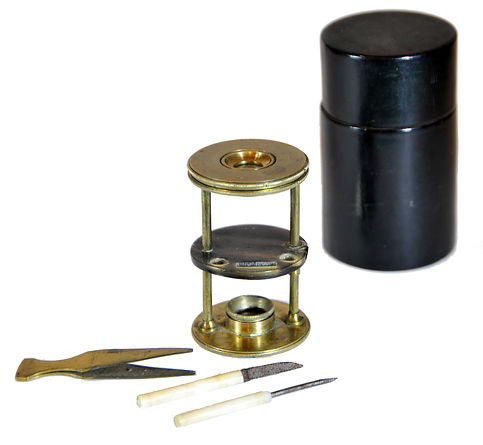
Withering-type botanical microscope, 1780
The “Withering-type Microscope” is named for its inventor, Dr. William Withering (1741-1799), an English physician and botanist who graduated with a degree in medicine 1766 in Edinburgh. Inspired by the taxonomical work and systematic classification of Carl Linnæus (1707-1778), Withering (1776) applied the Linnaean taxonomical system of classification to British plants in a seminal, two volume work, A Botanical arrangement of all the vegetables naturally growing in the British Isles. The earliest reference to a small botanical microscope of Withering’s design appeared in the first edition of this book. There, Withering indicated this microscope was developed for field dissections of flowers and other plant parts. While there is no surviving example of this exact design, close relatives of this type do exist, made either completely of brass or of ivory with brass pillars. Ivory models can be tentatively dated to 1776-1785, as by 1787 a newer model with a hollowed stage in an all-brass configuration already predominated. In turn, it was preceded by the brief appearance of a transitional brass model but with solid stage of ivory or horn (seen here). This version is extremely rare and must have been produced in very small numbers. By 1787 all these varieties were not recorded anymore in the literature.

Withering-type botanical microscope, 1780
The “Withering-type Microscope” is named for its inventor, Dr. William Withering (1741-1799), an English physician and botanist who graduated with a degree in medicine 1766 in Edinburgh. Inspired by the taxonomical work and systematic classification of Carl Linnæus (1707-1778), Withering (1776) applied the Linnaean taxonomical system of classification to British plants in a seminal, two volume work, A Botanical arrangement of all the vegetables naturally growing in the British Isles. The earliest reference to a small botanical microscope of Withering’s design appeared in the first edition of this book. There, Withering indicated this microscope was developed for field dissections of flowers and other plant parts. While there is no surviving example of this exact design, close relatives of this type do exist, made either completely of brass or of ivory with brass pillars. Ivory models can be tentatively dated to 1776-1785, as by 1787 a newer model with a hollowed stage in an all-brass configuration already predominated. In turn, it was preceded by the brief appearance of a transitional brass model but with solid stage of ivory or horn (seen here). This version is extremely rare and must have been produced in very small numbers. By 1787 all these varieties were not recorded anymore in the literature.
References: SML: A242712; Goren 2014.
References: SML: A242712; Goren 2014.
Prof. Yuval Goren's Collection of the History of the Microscope

Chapter 41 (Cont.): Nachet of Paris, Grand Modèle Perfectionné, 1887-95
This is a good and interesting example of the large-sized microscope model by Nachet of Paris, signed on the base NACHET, 17 rue St Séverin, Paris. Thus, it can be dated from 1887-95. The grand modèle was Nachet's best and most elaborate microscope, featuring a very large double-pillar body with a unique base, designed personally by Camille Sebastien Nachet. As with other Nachet microscopes, the stand is generally very well made, unlike those of some other French makers of the later part of the century. Nachet's large microscope was undoubtedly the best French-made microscope of the 19th century.
A History of the Nachet Firm
Camille Sebastien Nachet (1799 – 1881) was a Parisian optician at the beginning of the 19th century. After serving in the French military, he began producing lenses for the renowned microscope manufacturer Dr. Charles Chevalier in 1834. Six years later, in 1840, he established his own small business at 16 Rue Serpente, Paris, under the name “Maison Nachet & Fils.” Initially, he sold achromatic lenses for microscopes to various manufacturers in France and abroad. He later started producing his own microscopes based on the drum-type base models that had been made previously by other manufacturers in England and France. By the late 1850s, Nachet was recognized alongside Chevalier and Oberhauser as one of the three leading microscope makers in Paris.
At the Great London Exhibition in 1851, both Chevalier and Nachet showcased examples of their instruments. After evaluation, it was announced that while Nachet's objectives were considered inferior to those of the leading English makers, his instruments were well-designed and manufactured, and his lenses surpassed those of other European manufacturers. As a result, he was awarded a gold medal, while Dr. Chevalier (his former employer) received only an honorable mention.
In 1862, Camille Nachet relocated his optical workshop to 17 Rue St. Severin, Paris. By 1880, due to declining health, he was succeeded by his son, Jean Alfred Nachet (1831-1908). At that point, the company name changed from Nachet et Fils to A. Nachet, and the instruments were simply marked “Nachet.” Camille Nachet passed away in 1881.
In 1890, the firm’s name reverted to Nachet et Fils. By 1898, Nachet had acquired the other Parisian optical firms of Hartnack et Prazmowski, as well as Besu, Hausser et Cie, making it the principal microscope manufacturer in France. The firm continued to thrive well into the 20th century.


© Microscope History all rights reserved
References: Harvard 1862: 14; Nuttall 1979: 55; Golub: No. 136 (earlier version); Boerhaave: V07198, V07199; Jeroen Meeusen; Wissner.