
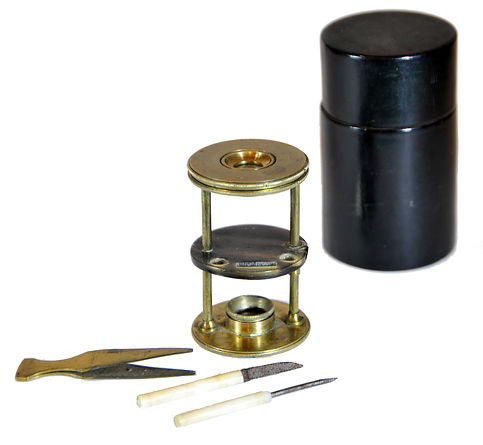
Withering-type botanical microscope, 1780
The “Withering-type Microscope” is named for its inventor, Dr. William Withering (1741-1799), an English physician and botanist who graduated with a degree in medicine 1766 in Edinburgh. Inspired by the taxonomical work and systematic classification of Carl Linnæus (1707-1778), Withering (1776) applied the Linnaean taxonomical system of classification to British plants in a seminal, two volume work, A Botanical arrangement of all the vegetables naturally growing in the British Isles. The earliest reference to a small botanical microscope of Withering’s design appeared in the first edition of this book. There, Withering indicated this microscope was developed for field dissections of flowers and other plant parts. While there is no surviving example of this exact design, close relatives of this type do exist, made either completely of brass or of ivory with brass pillars. Ivory models can be tentatively dated to 1776-1785, as by 1787 a newer model with a hollowed stage in an all-brass configuration already predominated. In turn, it was preceded by the brief appearance of a transitional brass model but with solid stage of ivory or horn (seen here). This version is extremely rare and must have been produced in very small numbers. By 1787 all these varieties were not recorded anymore in the literature.

Withering-type botanical microscope, 1780
The “Withering-type Microscope” is named for its inventor, Dr. William Withering (1741-1799), an English physician and botanist who graduated with a degree in medicine 1766 in Edinburgh. Inspired by the taxonomical work and systematic classification of Carl Linnæus (1707-1778), Withering (1776) applied the Linnaean taxonomical system of classification to British plants in a seminal, two volume work, A Botanical arrangement of all the vegetables naturally growing in the British Isles. The earliest reference to a small botanical microscope of Withering’s design appeared in the first edition of this book. There, Withering indicated this microscope was developed for field dissections of flowers and other plant parts. While there is no surviving example of this exact design, close relatives of this type do exist, made either completely of brass or of ivory with brass pillars. Ivory models can be tentatively dated to 1776-1785, as by 1787 a newer model with a hollowed stage in an all-brass configuration already predominated. In turn, it was preceded by the brief appearance of a transitional brass model but with solid stage of ivory or horn (seen here). This version is extremely rare and must have been produced in very small numbers. By 1787 all these varieties were not recorded anymore in the literature.
References: SML: A242712; Goren 2014.
References: SML: A242712; Goren 2014.
Prof. Yuval Goren's Collection of the History of the Microscope
Chapter 31: Early Microscopes by Andrew Ross
Andrew Ross (1798–1859) was a prominent English optician and microscope manufacturer known for establishing one of London's most successful optical firms during the 19th century. His instruments, celebrated for their superior brass craftsmanship and innovative engineering, set a high standard in Victorian microscopy.
Ross is particularly recognized for several key technical innovations:
1. The Ross Bar-Limb (1842): This design featured a robust triangular limb that effectively integrated the body tube, stage, and condenser into a single, stable pillar structure. The bar-limb design became the de facto standard in British microscope manufacturing throughout the century.
2. Collaboration with Joseph Jackson Lister (1786–1869): Ross partnered with Lister to pioneer achromatic lenses, which effectively addressed chromatic aberration. This advancement significantly enhanced image sharpness and fidelity, marking a substantial milestone in optical development.
3. Y-Shaped Base: His notable models, including the Large No. 1, were characterized by a unique splayed "Y-shaped" base, a design that offered enhanced stability over traditional tripod configurations, allowing for more secure positioning during observation.
4. Literary Contributions: Ross authored the seminal work, *The Microscope*, initially published as an entry in the *Penny Cyclopaedia* (1839) and subsequently released as a standalone volume. This influential text elucidated the principles and mechanics of optical instruments, solidifying his impact on the field beyond manufacturing.
.jpg)
.jpg)
.jpg)

© Microscope History all rights reserved


Large No.1 Bar-limb Microscope by Andrew Ross, 1849
This microscope reflects the popular English bar-limb design first introduced by Andrew Ross in 1842. This design became the standard for many British microscope makers throughout the second half of the 19th century. The British microscopes had long tubes and were based on the bar-limb concept having a Y-shaped base holding an inclining tube that holds the mirror, stage, rack and pinion system for coarse focusing and the "bar" holding the tube. This concept was maintained by most of the dominant makers of the second half of the 19th century including Powell and Lealand, Ross, Dollond, Baker, and many others. Some conservative companies (i.e., Powell and Lealand) continued the manufacture of bar-limb microscopes into the 20th century, long after the improved continental design became popular and was adopted by most modernized British makers (e.g., Watson, Swift & Son and others).
This large microscope is signed on the 'Y' shaped foot, 'A. ROSS, LONDON, No 398' should date to 1849.


Ross Microscope Fitted With Wenham's Binocular, produced ca. 1840, modified ca. 1860
This binocular microscope is marked on its 'Y'-shaped foot with the inscription 'A. ROSS, LONDON'. A. Ross did not assign serial numbers to his microscopes until August 1842. The microscope is equipped with Wenham binocular tubes, which were introduced after 1860. The term "Wenham microscope" primarily refers to the stereoscopic binocular design invented by Francis Herbert Wenham (1824–1908) in 1860. This design revolutionized microscopy by enabling researchers to view specimens with both eyes, resulting in a three-dimensional or "ortho-stereoscopic" image that is much more comfortable for extended periods of observation.
Wenham chose not to patent his design, which allowed it to be adopted by nearly every major British and American manufacturer in the 19th century, including Ross, Smith & Beck, and Swift & Son. The original Wenham design performed best with low-power objectives, up to about a 1/4 inch focal length. At higher magnifications, the image in the slanted tube often became dim or distorted, resulting in uneven illumination between the eyes. This design remained the standard for stereoscopic viewing for almost 50 years until more symmetrical binocular designs were developed in the early 20th century.


